

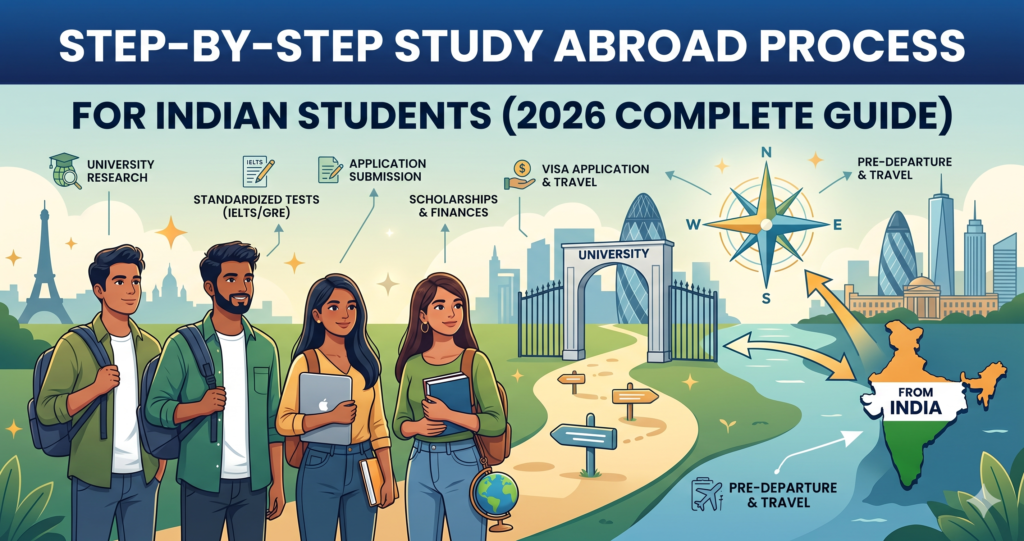
From the first conversation at home to the day you board your flight — here is everything you actually need to know
Every student I have ever worked with has asked me some version of the same question at the start of our first conversation:
“Where do I even begin?”
And honestly, that question makes complete sense. Studying abroad involves so many moving pieces — country selection, exams, applications, visas, finances, and accommodation — that the whole thing can feel overwhelming before you have even started.
Here is what I tell every student who asks: the process is not nearly as complicated as it looks. It only feels that way when you are staring at all the pieces at once without a clear sequence. Break it down step by step, give yourself the right timeline, and what felt impossible starts feeling very manageable.
That is exactly what this guide is for. I am going to walk you through the entire journey — from figuring out your goals to settling into life abroad — in a way that is honest, practical, and built around how the process actually works for Indian students in 2026.
Let us start at the beginning.
How Long Does the Whole Process Take?
Before we get into the steps, you need to know this: the students who have the smoothest experiences are almost always the ones who started early.
Ideally, you want to begin 10 to 15 months before your target intake. Here is roughly how that time breaks down:
| Stage | Approximate Timeline |
|---|---|
| Research and goal-setting | 2 to 3 months |
| Exam preparation | 2 to 4 months |
| University applications | 1 to 3 months |
| Admission decisions | 1 to 3 months |
| Visa processing | 1 to 2 months |
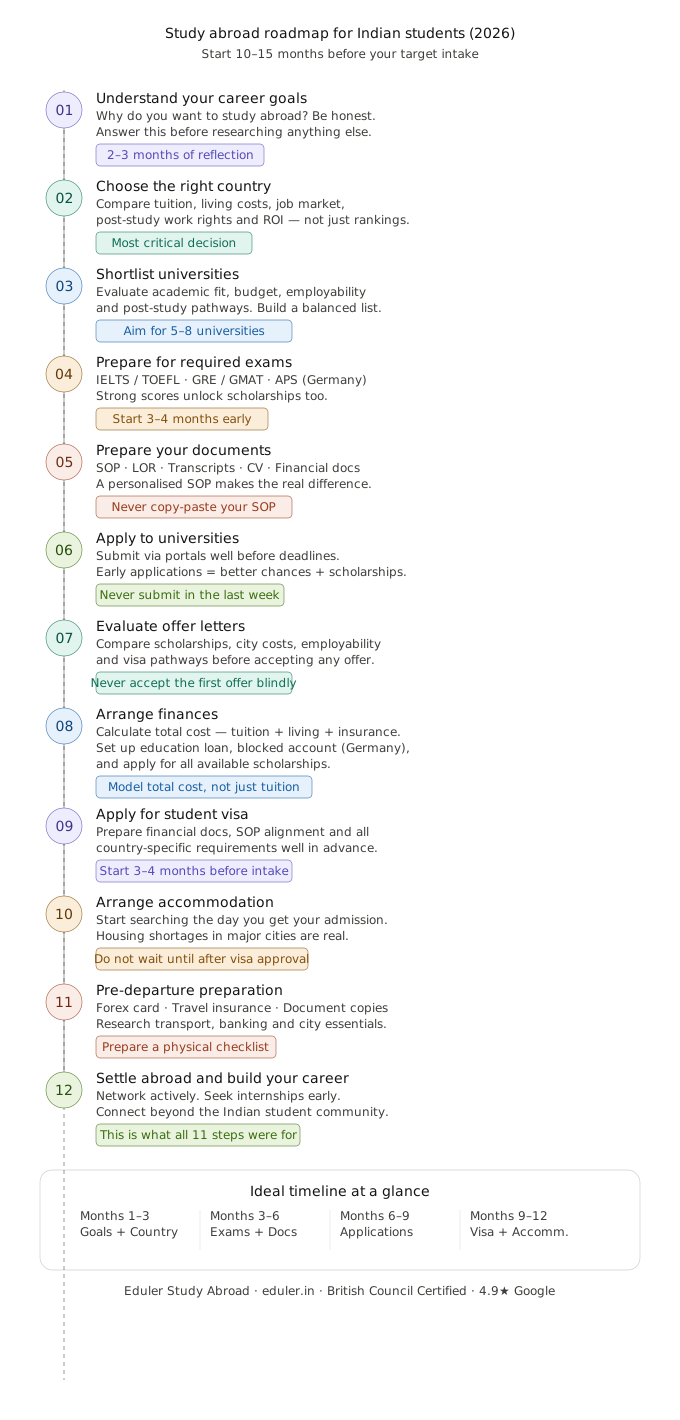
Starting late compresses every one of these stages. You end up rushing your SOP, missing early-round scholarships, and applying to universities that still have spots rather than universities that are actually right for you. Starting early gives you options. Options are everything in this process.
Step 1: Get Honest About Your Goals
I know this sounds obvious. But I have worked with hundreds of students, and I can tell you with complete confidence that the ones who struggle most are the ones who skip this step.
Before you research a single university or compare visa requirements, sit with these questions and answer them honestly:
Why do you actually want to study abroad? Not the answer that sounds good — the real one. Is it because of genuine career aspirations in a specific field? Because you want international exposure? Because you want to work in a particular industry that has its strongest ecosystem abroad? Or is it because everyone around you seems to be going, and you feel like you should too?
There is no wrong answer here. But knowing your real reason shapes every decision that follows — which country makes sense, what kind of university fits your goals, how to calculate whether the investment is worth it for your specific situation.
Also ask yourself: what do you want your life to look like five years after graduation? Where do you want to work? How important is the option to settle abroad versus returning to India? What salary range do you need to justify this investment for your family?
Students who can answer these questions clearly make better decisions dramatically at every subsequent step. Students who cannot end up being steered by trends, friends, and marketing rather than their own genuine interests.
Step 2: Choose the Right Country
This is where I see the most emotional decision-making — and the most avoidable mistakes.
Different countries offer genuinely different advantages, and the right choice depends entirely on your field, your budget, and your post-graduation goals.
| Country | Strongest For | Key Advantage |
|---|---|---|
| Germany | Engineering, STEM, data science | Near-zero tuition at public universities |
| Ireland | Technology, data analytics, AI, finance | Excellent tech job market, English-speaking |
| France | Business, luxury, management, hospitality | Affordable public education, growing English programs |
| UK | One-year master’s programs, finance, law | Speed and brand recognition |
| Canada | Varied fields | Clear immigration pathways |
| Australia | Balanced lifestyle, healthcare, education | Post-study work flexibility |
The things you should be comparing are not just tuition fees. Look at total living costs city by city, post-study work visa duration, part-time work rights during your degree, realistic job market conditions for international graduates in your specific field, language requirements for daily life, and the currency trajectory relative to the rupee.
A country that looks affordable on the surface can become expensive when you factor in accommodation in a major city. A country with higher tuition can deliver stronger ROI if the job market and salary levels justify it.
Take your time here. This decision has more long-term impact than almost any other choice in the entire process.Also Read Best Study Abroad Consultants in Delhi
Step 3: Shortlist the Right Universities
Once you have a country in mind, it is time to find the universities that actually fit your situation — not just the ones that appear first in a Google search or rank highest on a global table.
There are four things I always ask students to evaluate for every university on their list:
Academic fit — Does your academic profile meet the eligibility requirements? What are the GPA expectations, backlogs policy, and test score requirements for this specific program?
Budget reality — What is the actual tuition for this program, not the headline figure? How does the cost of living vary between university cities? Some universities charge modest tuition but are located in cities with very high accommodation costs.
ROI and employability — What do graduates from this program typically go on to do? What are the industry connections? Are there internship opportunities built into the program? A lower-ranked university with strong employer relationships in your target industry can outperform a prestigious institution with poor career placement.
Post-study work pathways — Does this university’s location support the post-graduation career plan you described in Step 1? Being in Dublin matters if you want to work in tech. Being in a smaller German city may matter less if your goal is to eventually return to India.
One important note: do not shortlist only your dream universities. Build a balanced list that includes some ambitious options, some realistic ones, and a couple of safe choices. This is not about settling — it is about making sure you have options when decisions come back.
Step 4: Prepare for Required Exams
This step tends to get underestimated more than any other — and it costs students every year.
Here is what most students do: they decide on their target country and universities, figure out what exams are required, and then realise they have six weeks before the application deadline. Six weeks is not enough time to prepare well for IELTS, GRE, or GMAT.
Start exam preparation early. Ideally, begin 3 to 4 months before you need the score. Here is what different destinations typically require:
English proficiency — IELTS, TOEFL, PTE, or Duolingo are required for almost every destination. Each university sets its own minimum score, and some programs within the same university have different requirements. Check program-specific requirements, not just university-wide minimums.
Competitive exams — GRE is required for most master’s programs in the US and some in other countries. GMAT is standard for MBA programs globally. Check whether your target programs require these and what competitive scores look like for your profile.
Country-specific requirements — Germany requires APS (Academic Evaluation Centre) certification for Indian students. This is a verification process for your academic credentials that takes time to complete. France’s Campus France process has its own timeline. Factor these in early.
Test scores affect not just admissions but scholarships. A strong IELTS or GRE score can be the difference between a scholarship that meaningfully reduces your costs and no scholarship at all.
Step 5: Build Your Application Documents
This stage is where many students underestimate how much preparation matters — and where the quality gap between applicants becomes most visible to universities.
Your core documents will typically include academic transcripts and mark sheets, your passport, a CV or resume, letters of recommendation, and your Statement of Purpose.
Your Statement of Purpose deserves serious attention. This is not a formality. Admissions committees read hundreds or thousands of SOPs. The ones that stand out are specific, personal, and clearly connected to the program being applied to. They explain not just what you want to do but why this specific program at this specific university is the right path to get there.
The most common SOP mistake I see is students writing a generic document and making minor tweaks for each university. Admissions readers can tell immediately. Write each SOP with genuine thought about why that particular program fits your goals.
Letters of recommendation matter more than students expect. Ask people who know your work and capabilities well, give them enough context about what you are applying for and why, and give them plenty of time. A strong, specific letter carries significantly more weight than a generic one from a more impressive title.
Financial documents will be scrutinized carefully at the visa stage. Start organizing these early. Different countries have different requirements — Germany’s blocked account requirement is specific and must be set up in advance — and last-minute financial document preparation is one of the most common sources of visa delays.
Step 6: Apply to Universities
Applications are submitted through university portals, centralised admission systems, or platforms like UCAS for the UK. Each has its own process and deadlines.
The single most important thing at this stage: do not miss deadlines, and do not leave applications to the last week. Early applications often get more favourable consideration, especially at universities with rolling admissions. Late applications are sometimes reviewed against reduced remaining spots.
Track your deadlines in a calendar with reminders set well in advance. Have all your documents finalized before you begin submitting, so you are not rushing to complete your SOP the night before a deadline.
If you are applying to Germany, remember that the APS process needs to be completed before you can apply to many universities. Build that timeline into your planning from the very beginning.
Step 7: Evaluate Your Offer Letters Carefully
When the decisions start coming in, resist the urge to accept the first offer you receive — even if it is from your first-choice university.
Compare offers across several dimensions. Look at whether the offer is conditional or unconditional, and what conditions you need to meet. Look at any scholarship included and how it affects the total cost. Compare the city costs for each university location, because the same tuition at two universities can result in very different total annual expenses depending on where they are located.
Think about employability specific to each location. And consider your visa pathway — some program structures support better visa outcomes in certain countries than others.
The goal is to make the final decision with full information, not just the excitement of getting an acceptance. Also Read Best Study Abroad Consultants in Noida
Step 8: Sort Out Your Finances
This is the stage that separates well-planned study abroad journeys from stressful ones.
Before you confirm your enrollment, calculate your total cost of attendance. That means tuition, accommodation, food, transportation, health insurance, visa fees, flight costs, and a realistic emergency fund. Do not use the university’s estimated minimum — build your own honest estimate based on the city, your lifestyle, and your specific situation.
If you need an education loan, begin the process early. Education loans take time to process, and some visa applications require proof of funds before they can be approved. Germany specifically requires a blocked account showing proof of €11,208 (as of 2024, verify the current figure) before the visa can be issued.
Research scholarships at this stage too, even if the application deadlines have passed for this cycle. Understanding what is available helps you plan better and apply strategically for future intake scholarships.
Step 9: Apply for Your Student Visa
The visa process is where careful preparation makes the most difference — and where careless preparation causes the most damage.
Every country has different requirements. Germany’s process involves APS certification, a blocked account, and a detailed financial and academic documentation package. The UK uses a CAS (Confirmation of Acceptance for Studies) issued by your university as the basis for your visa application. Canada’s SDS (Student Direct Stream) pathway has specific eligibility criteria.
Start your visa application well in advance. Visa processing times vary by country and season — during peak application periods, processing can take significantly longer than the stated average.
The key things to get right: your financial documents must be complete and consistent. Your SOP for the visa application should align coherently with your academic history and your reasons for choosing that specific country and program. Any gaps in your profile — employment gaps, academic gaps, previous visa refusals — need to be addressed honestly and clearly.
If your visa application is complex in any way, this is the stage where professional guidance on documentation pays the most dividends.
Step 10: Arrange Accommodation Early
This is one of the most underestimated logistical challenges — and accommodation shortages in major university cities have become more severe in recent years.
University dormitories fill up quickly. In cities like Munich, Dublin, and Paris, student accommodation waitlists can stretch for months. Start your accommodation research as soon as you have a confirmed admission, not after you receive your visa.
Your options typically include university dormitories (apply immediately after admission confirmation), shared apartments with other students (platforms like WG-Gesucht for Germany, Daft.ie for Ireland), private student residences, and private rentals.
When evaluating options, consider the commute to your university, proximity to grocery stores and public transport, safety of the neighborhood, and the total monthly cost including utilities.
Step 11: Final Preparations Before Departure
The weeks before departure tend to be simultaneously exciting and chaotic. Having a checklist helps.
Documents to carry in both physical and digital copies: passport, visa, offer letter, accommodation confirmation, travel insurance, financial documents, and emergency contact information.
Financial setup: Arrange a forex card before you leave — it gives you much better exchange rates than airport exchanges or ATM withdrawals abroad. Research whether your Indian bank account has international transaction capabilities or whether you need to set up a local bank account immediately on arrival (some countries allow this in advance, some require in-person setup).
Insurance: Student health insurance is mandatory in most countries. Germany requires proof of insurance before you can enroll. Sort this out before departure.
Practical research: Know the public transport system in your city before you arrive. Know roughly where things are. Understand what a typical monthly grocery budget looks like. These small things make the first few weeks significantly less stressful.
Step 12: Arrive, Settle In, and Start Building Your Future
This is the step that every other step has been working toward — and it deserves as much intentionality as everything that came before it.
Studying abroad is not just about getting a degree. The students who get the most out of the experience are the ones who treat their time abroad as an active investment, not just a passive credential.
Make an effort to build genuine relationships with local students and international peers from other countries — not just with other Indian students. Join clubs, attend industry events, go to career fairs. These connections often matter more to your career than your grades.
Start looking for internship opportunities early. In countries like Germany and Ireland, internships are frequently a pathway into full-time employment. Companies hire interns they already know; if you wait until your final semester to start looking, you are behind.
Work on your communication skills in the local context. Even in English-speaking countries, professional communication norms differ from India. Adapt early.
And give yourself time to genuinely enjoy being abroad. The cultural exposure, the independence, the perspective shift — these are part of what you came for. Do not spend the whole experience anxious about what comes next.
Common Mistakes That Set Students Back
I want to share these because they are all avoidable, and they come up consistently:
Applying too late. Early applications mean more scholarship availability, more accommodation options, and more time to fix problems if they arise.
Choosing a country based on trends. What is popular on Instagram right now has no relationship to what is right for your career goals and financial situation.
Underestimating living costs. Students consistently budget for tuition and forget to model accommodation, food, transport, insurance, and the unexpected expenses that always come up.
Writing a generic SOP. Admissions teams read thousands of these. Specificity is the only thing that stands out.
Ignoring the post-study work pathway. Your ability to work after graduation determines your ROI. Research this for your specific field and destination before you commit.
Relying on a single source of information. Reddit, YouTube channels, AI tools, and consultants all have blind spots. Triangulate.
Frequently Asked Questions
What is the first step to studying abroad from India? Start with an honest assessment of your career goals and budget before you research universities or countries. The students who skip this step end up making decisions driven by trends rather than their own genuine interests.
When should Indian students start preparing for study abroad? Ideally 10 to 15 months before your target intake. This gives you time to prepare for exams properly, apply in early rounds, and handle visa processing without rushing.
Which exams are required to study abroad? It depends on your destination. IELTS or TOEFL is required for almost all English-language programs. GRE is standard for US master’s programs. GMAT for MBA programs. Germany requires APS certification for Indian students. Always check program-specific requirements.
Can I study abroad for under ₹15 lakhs per year? Yes, with the right planning. Germany’s public universities offer near-zero tuition, and with careful city selection and part-time work, total annual costs can stay within this range. Poland and parts of France are also viable with scholarship support.
How long does visa processing take? It varies significantly by country and season. Germany student visas typically take 6 to 12 weeks. UK visas are often faster. Canada can vary more widely. Always build more buffer time than the stated average into your planning.
Do I need a study abroad consultant? Not necessarily. Students with clear goals, straightforward profiles, and the time to manage the process independently can absolutely apply on their own. A good consultant adds the most value when your profile is complex, you are uncertain about your direction, or you are applying to destinations with intricate documentation requirements like Germany.
A Final Word
The study abroad process can feel overwhelming when you look at it all at once. But every student who has done it started from the same place you are right now — staring at a long list of unknowns with no idea where to begin.
The key is simply to start — with your goals, with honest research, and with enough time to do each step properly rather than rushing through them all at once.
You do not need to have everything figured out before you begin. You just need to take the first step with intention.
At Eduler Study Abroad, we help students across Noida and Delhi NCR navigate this journey from start to finish — with honest guidance and genuine care for where you end up, not just whether you get there. If you want to talk through your specific situation, we would love to have that conversation.
 Call 9957756240 to book a free consultation with Eduler. Let’s figure out your roadmap together.
British Council Certified | 4.9★ Google Rating | 32+ Countries | 1,750+ University Partners